Manchester Piccadilly – Huddersfield – Bradford Interchange – Bradford Forster Square – Menston – Shipley – Bingley – Bradford Forster Square – Bradford Interchange – Manchester Victoria
So, are we there yet? The plan was to try to complete the task by yesterday, so that I had today free to mop up anything missed, wherever in the UK that might be. My plans have changed over the week but I know of two outstanding places to visit. They’re both easy enough to get to, but one is best left for the journey home. So just one today. But there’s no rush. On Monday I saw an interesting aqueduct at Marple, maybe I should visit that? But if my plan was Marple why would my next train be to Huddersfield? It was like this.
Train 55 – Manchester Piccadilly to Huddersfield
Trip details
| From | Manchester Victoria | To | Huddersfield |
| Time due | 07:58 | 08:47 | |
| Actual Time | 08:02 | 08:50 | |
| Operator | TPE | Headcode | 1Z67 |
| Miles | 28m 14ch | ||
| Stations called at | 8 | Unit | 185137+185101 |
I was at Piccadilly in time for the train to Marple, which was waiting in the platform. One minute before it was due to leave a despatcher pressed the Train Ready to Start plunger, requesting that the signaller set up a route and clear the signal. But the train didn’t move and it became clear that there was no crew. A couple of minutes later I decided on Plan B, passing the train crew as I left the platform. That train probably wouldn’t have been more than two or three minutes late and a smart turnaround at its destination would have put it right back in its slot. But if you carry a Rover you have a permanent plan B. Don’t be afraid to use it!
I’d now decided to walk part of the Leeds and Liverpool Canal and visit the lock flights at Bingley. An added bonus was that I’d seen that the Shipley Glen tramway was open today, so I would try to ride on that.
The Huddersfield train was to leave from Platform 14 and the next stop after Piccadilly would be Victoria. Maybe you’re thinking: if there are trains between Piccadilly and Victoria why have I been walking or taking the tram whenever I’ve needed to get from one to the other? You need a potted history.
I think of Piccadilly as three stations. The first consists of the low-numbered platforms that once served the Woodhead route. In the past almost all services using these platform entered and left Piccadilly by the East lines which diverge from the station throat at Ardwick. These services were once electrified at 1500V DC and the gantries are still visible even though some of the routes have been converted to the current standard (25kV AC) and others are no longer electrified at all.
The second station is the bulk of the main trainshed. Mostly, trains from here went to Stockport and then on to London, Birmingham, Wales, Buxton and various other places. Trains on these routes mainly used the Fast pair of lines in and out of Piccadilly.
The final Piccadilly Station is formed of platforms 13 and 14. These are through platforms and separate from the main building. One end of these platforms lies adjacent to the main station but the lines here are not parallel to the main station, they diverge from it. The through lines carried busy services to Liverpool and (before the trams) Sale and Altrincham. Trains from the Stockport direction normally used the Slow pair of lines to get to and from 13 and 14.

That was the situation until the late 20th century., then two things happened: they built the Windsor Link and they opened the spur to the airport. A world of possibilities opened up as it became possible for far more services to access Piccadilly, rather than the less well-connected Victoria. The planners went mad. The thinking seemed to be: if it can be routed into Piccadilly then it definitely should be. And it should then continue to the airport.
Piccadilly became very busy indeed. The fairly strict demarcation between the Slow and Fast lines became history because of the need to squeeze the most out of the available infrastructure. Many trains were leaving the main trainshed on the Slow line, especially to reach the airport. Trains from 13/14 were routinely being routed across the station throat onto the Fast line. Trans-Pennine trains arriving on the East line were being routed right across the station to 13/14, expect for those that reversed in the main station before heading to the airport.
This was a recipe for congestion and delay. The biggest problem of all was platforms 13/14 and the line from there towards Liverpool and the Windsor Link. Known as the Castlefield Corridor this was jammed full of passenger trains yet still had to fit in hourly long, slow container trains to and from Trafford Park.
Delays were the norm. Several ‘something must be done’ articles/studies were commissioned and various options were discussed, and are still being discussed. The problem is that you can’t easily widen or otherwise increase capacity of a two-track railway that threads through the heart of a city and has three stations on it. But nothing of significance has ever happened. Well, not quite. It was decided that it would be a good thing if services into Victoria could be routed to the airport via Piccadilly. This could be used by Trans-Pennine trains from the north-east and Northern trains from West Yorkshire.
The scheme had its critics. I saw a talk by a railway historian bewailing the fact that the new link, known as the Ordsall Chord, would disconnect the Science and Industry Museum from the rail network. The museum, part of the Science Museum Group, occupies Liverpool Road Station, the original Manchester terminus of the Liverpool and Manchester Railway and, some claim, the world’s first inter-city station.
The argument was lost in the courts. Such things were always unlikely to carry much weight. The railways have often been ruthless when there’s conflict between history and modern operations and I suspect the rail link into the site saw no more than a handful of movements each year – if that. And it wasn’t as if the Science Museum Group didn’t have other rail-connected display space. A large museum at York comes to mind.
Anyway, the Ordsall Chord was built. It was intended to carry four trains per hour in each direction but today it carries just one. And it cost £100 million. There’s a quotation on Wikipedia from Andrew Haines, the chief executive of Network Rail.
“The Ordsall Chord is a classic example of a fantastic piece of infrastructure which has unlocked great new journey opportunities … but where the new infrastructure was not supported by a sufficiently rigorous operating plan. Nobody really looked at how we would reliably operate 15 trains an hour, across six flat junctions in the space of a few miles, with disparate rolling stock, much of which will have travelled for several hours picking up potential delay on the way.”
Rail Technology Magazine published an article arguing against the curve in 2011. It concluded
Investment in the Ordsall Chord, unless accompanied by investment in additional through capacity at Piccadilly, would seem a poor choice, and indeed by this reckoning is quite the least important element in the Manchester Hub proposals. One may only conclude that it is being given priority for other than the publicly stated reasons. On any rational calculation of investment and benefits the Ordsall curve would appear to offer only limited scope for increasing capacity, by comparison with the additional through platforms for Piccadilly.
There was an attempt to make better use of the chord. Do you remember the great new timetable meltdown of a few years ago? So Ordsall Chord was built, it cost a lot of money and it allows just one train an hour to run between Victoria and Piccadilly. And I’m about to use it.
I made my way along the (broken?) moving walkway and up the steps towards the through platforms. You arrive at a lounge area with plenty of seating and several passenger information screens. At busy times staff here will not allow you to go down onto the platforms before your train is due because the narrow island platform can become congested, but at this time of day on a Sunday there were no such controls. Instead there was was a very noisy Northern employee on the platform who really, really didn’t want anyone to step even a millimetre over the yellow line. I know it’s safety and everything but there is no crowding and no train in view so what’s the risk she was trying to mitigate?
My train arrived. It had come from the airport and was packed. I stood back to allow the throng to alight, each with their own suitcase. Almost everybody left the train here, so maybe the demand for a direct train to the north-east isn’t there? I’m being unfair because this was Sunday and Trans-Pennine Upgrade work meant that this train wouldn’t be able to get to the northeast. The line was blocked after Huddersfield.
We left Piccadilly, navigated the Castlefield corridor then the Ordsall Chord and arrived at Victoria. There were several announcements saying that the train was Huddersfield only and that passengers for Leeds should change here.
After Victoria it was another visit to Ashton-under-Lyne and Stalybridge. The next settlement was Mossley. I saw on the OS map that the station lies in the pleasingly-named area of Bottoms. As we approached Mossley there was a terrace of houses, presumable old railways workers’ cottages, facing onto the railway. The only access to their front doors appears to be from a path leading across their fairly narrow front gardens. I thought that an unusual setup then a couple of days after completing my trip I saw a photograph online somewhere of the same cottages. The residents are unhappy that the line is to be electrified so they’ll have to look out on ugly stanchions and wires.
Not long after Bottoms we entered a very long tunnel. It was at Standedge and nearly four miles long. It’s one of four tunnels here. The first was on the Huddersfield Narrow Canal and is Britain’s longest, deepest and highest canal tunnel. I’d like to pass through it one day. The next to be built was a single-track railway tunnel. Construction was speeded up by the railway buying the canal tunnel which could then be used for access and to remove spoil. Perhaps not surprisingly such a long single-track tunnel soon proved inadequate so another single-bore railway tunnel was built. Even this soon wasn’t enough so a new twin-track tunnel was built in the 1890s. This newest tunnel is still in use, the two single-track tunnels having been closed to trains in the 1960s but still open for maintenance and access purposes.
Interesting fact: the line through the Standedge Tunnel is the only long section of level track on this bendy, hilly, line so water troughs were placed in the tunnels in the days of steam so that engines could replenish their tenders as they passed through.
After the tunnel the ride is very pleasant with hills, rivers, the canal and old industrial buildings. Just the type of northern England journey I like. We passed through Slaithwaite (SLAH-wit) and no sooner said than done we were in Huddersfield.
For the record the train was a pair of class 185 units. These were the mainstay of TPE a few years ago. They’re fast and fairly modern but were ruined by being much too short (three cars) and rarely being used in multiple, leading to serious overcrowding on long routes such as Edinburgh to Manchester Airport and Manchester to Hull. TPE have a lot of new trains now and the situation is better.
It occurs to me that this is the first train I’ve used since Monday that isn’t operated by Northern. And the first with first class.
Train 56 – Huddersfield to Bradford Interchange
Trip details
| From | Huddersfield | To | Bradford Interchange |
| Time due | 09:04 | 09:38 | |
| Actual Time | 09:07 | 09:40 | |
| Operator | Northern | Headcode | 2W51 |
| Miles | 18m 60ch | ||
| Stations called at | 8 | Unit | 150222 |
I now needed to change to a local service. It starts its journey here and is heading to Leeds, although I’m be leaping off at Bradford. Last time I was on this line it was a Pacer. Today’s train is a step-up, but not by much, to a class 150.
It was almost time to depart but the doors remained closed. A chap sporting a very large beard got on at the rear cab and walked to the front cab. He released the doors then leapt onto the platform, blowing his whistle furiously and signalling to us not to approach the train using gestures he learned on a dairy farm. He walked back testing each set of doors individually until he was satisfied. We were allowed on.
We left Huddersfield three minutes late. I’d wondered what role the mad whistle man had. Initially I’d thought he was the driver, then possibly a fitter. He was the conductor.
Leaving Huddersfield there’s a lot of evidence of Trans Pennine Upgrade (TPU) work. A lot of fencing has been erected to allow workers by the side of the line to work safely without onerous working-too-close-to-the-track safety procedures being required.
We pass through Brighouse. A man, no longer in the first flush of youth, wearing a Friends of Brighouse Station hi-vis tabard is carrying two full watering cans. We’re soon back at Halifax and a quarter of an hour later Bradford Interchange.
For the second time in under 24 hours I walked to Forster Square, pausing to drink coffee at a bustling coffee shop. Bradford in the sunshine does seem to be a pleasant place. Forster Square, though, hasn’t improved since yesterday.
Train 57– Bradford Forster Square to Menston
Trip details
| From | Bradford FS | To | Menston |
| Time due | 10:38 | 10:57 | |
| Actual Time | 10:37 | 10:58 | |
| Operator | Northern | Headcode | 2D34 |
| Miles | 8m 64ch | ||
| Stations called at | 4 | Unit | 333014 |
My train is on the indicator but the train in the platform clearly isn’t it. There’s an LNER Azuma sitting there, bound for King’s Cross. The station was busier than yesterday as London-bound passengers arrived. After a few minutes the Azuma left, but there was no sign of my humble commuter stock. There were, however, two trains in an adjacent platform. I remembered that yesterday I’d had to walk to the further train on the platform so maybe that was the case today. Yes, the train was clearly in service – the doors were released – and had Ilkley displayed as its destination. I sat down but then remembered a couple sitting on a bench on the platform facing the empty track formerly occupied by the London express. Did they want this train?
I walked back towards the barrier and spoke to them. Yes, they did want the Ilkley service. They were very grateful and told me so many times. Why the station staff had made no attempt to notify anybody that the displayed information was wrong, I don’t know. Today is the first day of the new timetable so that might explain the glitch. Today is also the day the new Bradford Forster Square Platform 0 opens, although I understand no trains used it today.
After a few minutes we passed Shipley. Yesterday we’d turned right towards Leeds but today we’d go straight on towards Ilkley. Actually, we did turn right but then an immediate left. After Shipley was Baildon. I hadn’t really heard of this station until recently but it was the reason for this trip – this one station, served only by Bradford to Ilkley trains, is on a stretch of line I’d never travelled. This was my only tick of the day.
I could have just got off at Baildon but the train back wasn’t for some time, although it occurred to me later than I could probably have walked to the canal from there. I stayed on for two stops and alighted at Menston. They’re doing a lot of rebuilding work here and the footbridge is made of scaffolding. Seems to work, though.
Train 58 – Menston to Shipley
Trip details
| From | Menston | To | Shipley |
| Time due | 11:04 | 11:16 | |
| Actual Time | 11:03 | 11:16 | |
| Operator | Northern | Headcode | 2D67 |
| Miles | 6m 07ch | ||
| Stations called at | 2 | Unit | 333010 |
My next train, like the last, was an electric Northern class 333. I was only onboard for 13 minutes before we were back at Shipley, This is a triangular station, I think there’s only one other in the country (Earlestown?). One face of the triangle is served by trains from Bradford towards Skipton; one by trains from Leeds to Skipton and the third by trains from Bradford to Ilkley and Leeds. I found my way to the inside of the triangle and the station car park. From there I walked under a bridge and was pleased to see a sign directing me to the canal. At the end was a major road but no further directions to the canal. Great.
I crossed the road and walked to a busy junction. I could see that the road from that junction crossed the canal so I could probably get onto the towpath there. And so I could. It was a pleasant walk along the canal. Very soon I reached Saltaire, Titus Salt’s model village. I’ve been here before but it is worth a visit.
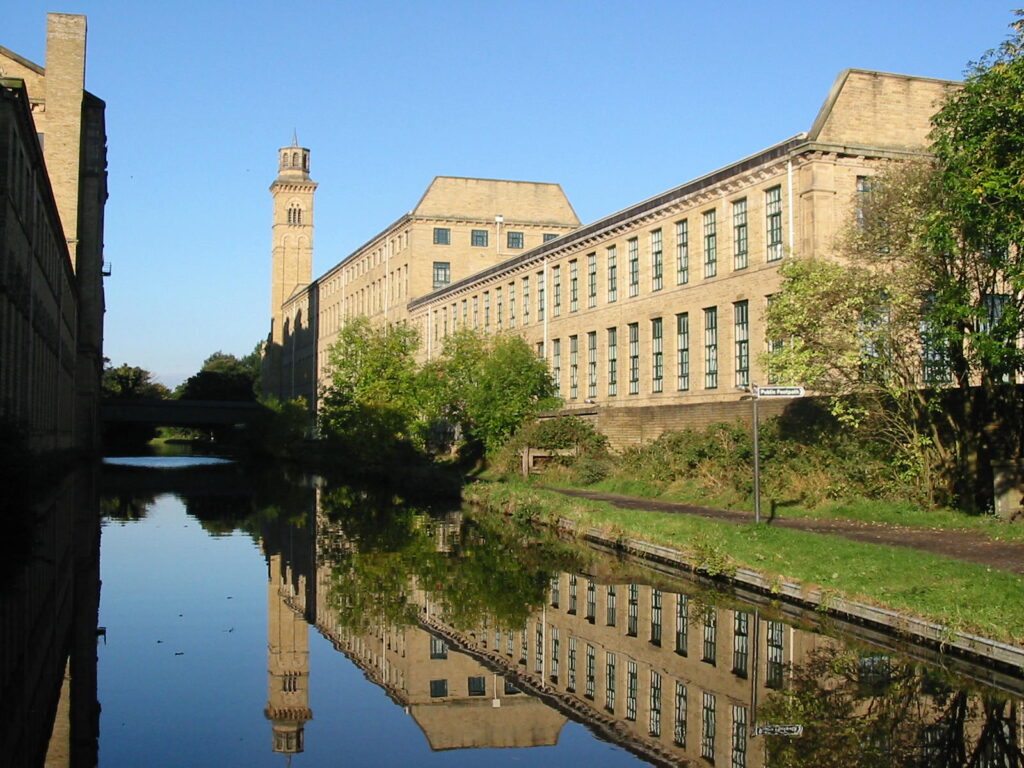
I left the canal just after Saltaire to find the tramway. The route was across an iron bridge over the River Aire then through Roberts Park. The park was heaving. It seemed that every family from Shipley, Bradford and beyond was paying a visit on this fine, sunny, Sunday. There was a play area and skatepark, a bandstand, cricket pitch and cafe. What a pleasure it was to be in the middle of hundreds of people enjoying themselves, for free.
On the far side of the park was a road, lined with hundreds of cars. Just beyond the road was a path leading to the tramway. I’ve walked past the tramway before but it wasn’t operating. Today it was. There was an event of some kind, with several hundred more people enjoying themselves. There were stalls, some vintage cars, drinks and a community choir singing. All very nice.
Funicular 1 – Shipley Glen Tramway
My fears that the crowds would mean a long queue for the tramway were not founded as I was able to board the very next ascent. The cars aren’t very large but the short journey time helps in preventing the queue becoming too long.
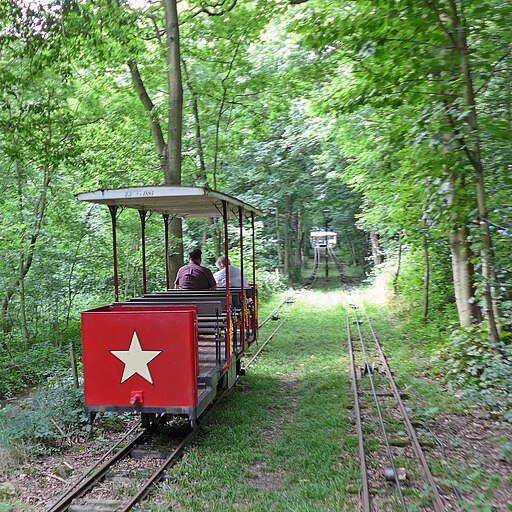
The tramway is described as Britain’s oldest cable tramway. It was opened in 1895 to enable visitors to get to a variety of attractions at the top, including a large funfair. The attractions are gone but the tramway remains, carrying transport enthusiasts, families and those who’d rather not walk for a quarter of a mile uphill.
From the top station I found a way back to the canal and continued to head west. My frustration at missing the Marple Aqueduct this morning was ameliorated by coming across one on this canal, the Seven Arches across the Aire.

Just after the aqueduct was a pub. Just the ticket.
The pub had a garden by the canal. It was a nice spot yet only one couple was sitting outside it. I went in to the bar. The beer was local and good. I saw a sign: “Yorkshire Tapas”. They were playing on the old-fashioned idea that a proper pub does not serve food, as the ‘tapas’ consisted of crisps, pork scratchings and so on. It’s their pub to run as they please. I just note that the place, in an idyllic position, was almost empty on a beautiful sunny Sunday. There were thousands of families within a mile, many of whom would have welcomed the chance of a Sunday Roast.
I continued along the canal as it became urban in nature. A busy road ran much too close by on one side. But then my objective came into view. There are two flights of locks here at Bingley, the Bingley Three Rise and the Bingley Five Rise. I love the canals, especially these engineering wonders.
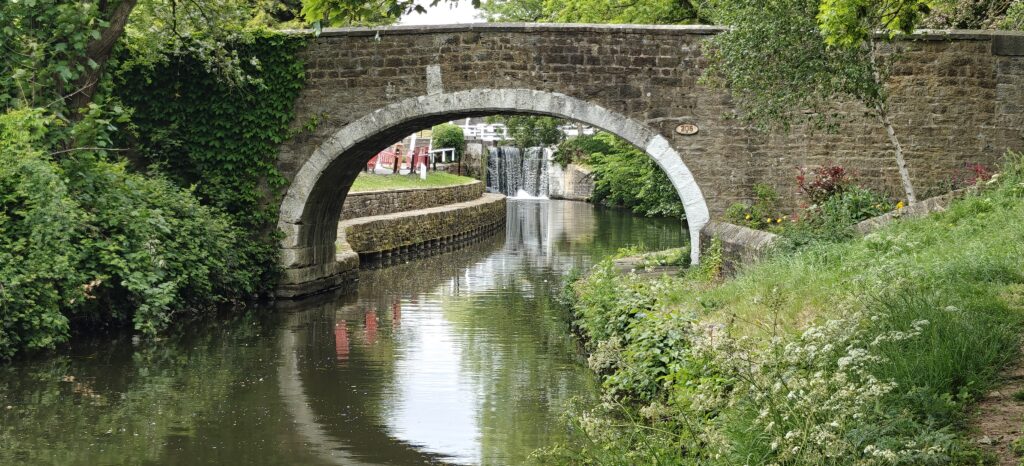
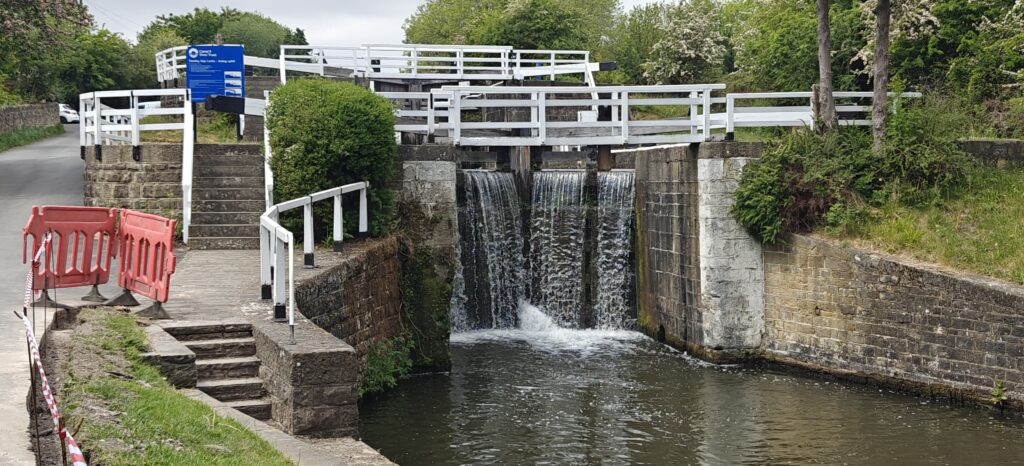


There is a footpath from the canal across the busy A650 so I took it. I was close to a station. But some food wouldn’t go amiss. I soon found The Brown Cow. Large and very busy, and I lacked a reservation. The first thing I saw as I approached the bar was an array of hand-pumps, perhaps eight in all, each serving a Timothy Taylor product. Even if I couldn’t get food I’d definitely stop for a pint. Could they fit me in? They could. I found a table that was reserved, but not for an hour or so, then ordered roast beef. It arrived within five minutes. Was it the best I’ve ever had? No. But I was tired and hungry. The roast dinner and the pint were exactly what I needed.

Train 59 – Bingley to Bradford Forster Square
Trip details
| From | Bingley | To | Bradford FS |
| Time due | 15:03 | 15:20 | |
| Actual Time | 15:02 | 15:17 | |
| Operator | Northern | Headcode | 2S85 |
| Miles | 5m 53ch | ||
| Stations called at | 4 | Unit | 333103 |
I walked the very short distance to the station and had only a short wait for a class 331 back to Bradford Forster Square. Passing Shipley I realised that I’d stopped on all three sides of the station’s triangle this weekend. I walked to Interchange and joined the busy platform.
Train 60 – Bradford interchange to Manchester Victoria
Trip details
| From | Bradford Interchange | To | Manchester Victoria |
| Time due | 15:39 | 16:35 | |
| Actual Time | 15:43 | 16:38 | |
| Operator | Northern | Headcode | 1J21 |
| Miles | 40m 27ch | ||
| Stations called at | 8 | Unit | 195119+195120 |
And so I caught another Northern Class 195 back along the Calder Valley to Victoria. A nice ride, but no longer unfamiliar.
Metrolink 5 – Victoria to Piccadilly
And back to the hotel. As usual there were no trains about to use the Ordsall Chord when I needed it hence the Metrolink.