Manchester Victoria – Rose Grove – Colne – Preston – Liverpool Lime St – Liverpool Central – Headbolt Lane – Moorfields – Headbolt Lane – Manchester Victoria
Having retrieved my case yesterday I now had my full complement of clean clothing for the rest of the week and was in the hotel I’d remain in for the rest of my trip. When younger I’d cram everything into a backpack and sleep somewhere different every night if it made travel arrangements easier. A combination of a slightly less capacious backpack and a desire for an easy life has made me change tactics. I now supplement the backpack with a small cabin case. This makes packing far easier. But I don’t really want to carry two bags everywhere I go, so like to change hotels less often, leaving my belongings in my room and using the backpack as a day bag.
So, where are we on my mission? I’ve finished Wales, Scotland, all of England south of the East Midlands, almost all of Yorkshire and all of the north-east. The real outstanding area to tackle is around Manchester. I’ve travelled on all of the through routes over the years but not in any planned way. Earlier in the week I started my final assault by arriving from the New Mills Central direction then going to Rose Hill, Marple; Glossop and Hadfield.
There was just the rest to worry about and the Manchester rail network is large and complex, though less so since the trams took over several lines.
Anyway, let’s go.
Train 36 – Manchester Victoria to Rose Grove
Trip details
| From | Manchester Victoria | To | Rose Grove |
| Time due | 07:03 | 07:54 | |
| Actual Time | 07:03 | 07:54 | |
| Operator | Northern | Headcode | 2N91 |
| Miles | 29m 40ch | ||
| Stations called at | 7 | Unit | 156427 |
Manchester has two large stations. I was staying very near to Piccadilly as my previous experience of the city suggested that I would be using this station a lot. Victoria is a bit of an unknown quantity. I’m not even certain that I’ve ever used it. But that is about to change.
It was a nice morning so I decided to walk to Victoria. It proved to be easy enough. At one point the width of the pavement meant that I misinterpreted Google Maps and took a narrow road blocked by a bin lorry instead of the main road, and I managed to get trapped inside Shudehill bus station. It was similar to what had happened on Wednesday at North Shields. If you try to take a short cut through the bus side of the bus station you cannot get out – eventually you need to give up, retrace your steps and try again.
Manchester Victoria is one of those ugly sister stations. Wigan has its Wallgate, Wakefield its Kirkgate. They run mainly local services operated by older diesel trains. But Victoria is coming up in the world. Many services are now electric and the station itself is an interesting mix of old and new. The shabbiness of many of our older stations has been swept away over the last few years.
Victoria is still just a shadow of its glory days when it had 17 platforms, including a very long one that connected with Manchester Exchange. Exchange had five platforms and is now just a distant memory. But I suspect with modern trains and contemporary ways of working today’s Victoria can probably handle nearly as many passengers as the old station even if it does only have six platforms.
It was still early so I had trouble finding coffee, having to use a self-service machine in, I think, Smiths. It wasn’t great.
My train had come from Wigan Wallgate. Last time I was at Wallgate it stank of diesel fumes, but some of the worst offending trains (the Pacers) have now been withdrawn. This morning’s train was a Class 156. You already know about those.
The line had plenty to see. We were alongside the Rochdale Canal at times. I like to see canals but I prefer to walk along them or (best of all) be on a narrow boat. We called at, or passed, several places I’d heard of but knew little about including Rochdale and Todmorden. We passed several nice looking old towns, each with its prominent show-off church. Just after Littleborough we passed through a long tunnel. During the later parts of the journey there were sunlit hills. All in all a nice ride.
I got off at Rose Grove, another floral name. My good-mood bubble was, if not burst, leaking . There was a long island platform so at least I wouldn’t have to walk or climb stairs to my next train but the facilities are what is euphemistically termed basic. The M56 passes close by so there was constant traffic noise. Actually, in the sun, Rose Grove was tolerable but would not be a nice place to wait for any time in poor weather, even though there was a sizable bus shelter that would keep off the rain. I’m not sure this station ever had glory days, but until 1989 it was the starting point for a Saturday service for holidaymakers that went all the way to Paignton. That seems unthinkable today.
Train 37 – Rose Grove to Colne
Trip details
| From | Rose Grove | To | Colne |
| Time due | 08:13 | 08:34 | |
| Actual Time | 08:17 | 08:37 | |
| Operator | Northern | Headcode | 2N12 |
| Miles | 7m 09ch | ||
| Stations called at | 5 | Unit | 156415 |
I didn’t have to stay at Rose Grove for long. My last train had taken a bit of a curving route from Victoria. It had been heading east then turned towards the north-west at Todmorden and was heading due west when I reached Rose Grove. It would continue west to its destination, Blackburn.
I crossed the platform for a train going in the opposite direction. This train, another Class 156, would branch off almost immediately, turning towards the north and Colne. We called at two very closely-space stations, Burnley Barracks and Burnley Central. Many school and college students disembarked here.
The next station, Brierfield, once had a traditional two-platform layout, the disused platform and track bed still in place. There was a large building next to the line that looks ex-military, or even ex-prison. All I can learn from Google Maps is that part of it houses an adult learning centre.
After Brierfield came Nelson. This is a large town but only has a single-track railway with an hourly service. Not good enough, railways. Nelson’s station seems confused about its own name. Some signs said Nelson Station, some Nelson Interchange. I don’t see what’s wrong with plain old Nelson, the name used on the railway timetables. Although the station doesn’t have a great train service it does have a decent modern building with at least a part-time ticket office. Presumably, as the word Interchange is now being bandied about, there’s a bus station, perhaps sharing facilities with the railway station. Yes, Maps confirms that. It also shows that the bridge carrying the railway over the road is surprisingly long as it carries what used to be an island platform with its buildings as well as the current and disused track formations. It’s also low at just 3.7m (12’3″). It appears that the Google camera car didn’t dare to drive through it.
After Nelson we continued to the terminus at Colne. As is so often the case this stump of a railway was once a through route and went to Skipton. Now it has a single line with a buffer stop and little else.
I had a few minutes to spare so maybe I could get a coffee or some water? I left the station and looked around. Nah, nothing to see here.
Anyway, the Colne line is another tick. In fact the line from Manchester Victoria to Toddy and Rose Grove is, as well.
Train 38 – Colne to Preston
Trip details
| From | Colne | To | Preston |
| Time due | 08:51 | 10:03 | |
| Actual Time | 08:51 | 10:05 | |
| Operator | Northern | Headcode | 2N83 |
| Miles | 29m 10ch | ||
| Stations called at | 17 | Unit | 156415 |
Back on board the 156 I settled into a seat in my favourite spot, facing and on the right. Back through Nelson and the two Burnley stations. But not the third, although I’d passed through Burnley Manchester Road on the way out. And I suppose Rose Grove counts as a Burnley station, so the town is well served.. We rejoined the double line at Rose Grove and followed the path that our last train took after we got off, to Blackburn. You wouldn’t believe the number of holes.
The train stopped at many (17) stations. A couple were by request, although I don’t remember if we actually called or not. Some place names were familiar: Accrington, Blackburn. Some weren’t: Hapton, Rishton. I’d heard of Church and Oswaldtwistle but I don’t know how. This is a nice-looking station with cared-for planters and a poster asking ‘Do you like gardening? Do you want to meet new friends’? It was looking for volunteers to join the community rail team. These are common now and are bunches of volunteers who provide extra touches to their local stations. It’s a great idea but I bet that few volunteers are under 65.
On to Pleasington, apparently pronounced Plezington. There was an obligatory floral name in Cherry Tree. But soon I started to recognise names that I must have learned when playing Simsig: Bamber Bridge. Lostock Hall. Immediately after Lostock Hall we passed over the WCML on a bridge at right angles then curved sharply to join the main line for the short run into Preston.
Train 39- Preston to Liverpool Lime Street
Trip details
| From | Preston | To | Liverpool Lime St |
| Time due | 10:28 | 11:20 | |
| Actual Time | 10:28 | 11:19 | |
| Operator | Northern | Headcode | 1F08 |
| Miles | 35m 19ch | ||
| Stations called at | 6 | Unit | 331101 |
Preston is a busy station. I bought some coffee and went to my platform . It was bustling, but there were several trains on the display so not everybody would board my train. There was a problem on the WCML just north of me so Avanto West Coast trains to London were delayed but my Northern service was on time. It was a Class 331. This is an electric version of a CAF Class 196, so is modern. It was four cars long (some of this class are only three) and was more than adequate for this service to Liverpool.
We headed south on the WCML, stopping at Leyland. This is another of those places I’m more used to seeing out of the corner of my eye as we pass at 125mph. We passed Euxton junction, where trains to Bolton and Manchester diverge. I’d ridden that line yesterday on the way from Edinburgh. Next was Euxton Balshaw Lane. I thought we’d taken a branch, but no. The station platforms are on the slow lines which have become slightly separated from the fasts so it feels like a different line. And Euxton is not pronounced Yewkston, but Exton.
The WCML lost two of its tracks for a while as we sped south. Our next stop was Wigan North Western. This is another very busy station and an important junction But we were soon away, continuing up the WCML. This became four-track again but almost immediately we took a fork to our right. Our train was now running fast, omitting most stations. The next call was St. Helen’s Central, where a large number of people got on. Wikipedia says that the station was rebuilt in 1961 using a lot of local Pilkington Vitrolite glass. I thought Pilkington was in Warrington?
Just before the next stop, Huyton, was a trailing junction. Huyton was “Darling ‘arold’s” constituency. We’ve now merged onto the Liverpool and Manchester Line, the world’s first inter-city railway, opened in 1830. We pass through Edge Hill and the very impressive stone cutting with almost vertical walls on the approach to Lime Street before stopping at the terminus itself.
There was a nice rake of carriages in Lime Street in the livery of West Coast Railways, with a class 47 ready to take it out. It was a charter to Holyhead.
I notice a disused platform at Lime Street. Apparently it’s called Platform E, or sometimes platform 6 3/4. In any case it lacks rails.
Train 40- Liverpool Lime Street to Deansgate
Trip details
| From | Liverpool Lime St | To | Deansgate |
| Time due | 12:00 | 12:55 | |
| Actual Time | 12:00 | 12:59 | |
| Operator | Northern | Headcode | 2A16 |
| Miles | 31m 11ch | ||
| Stations called at | 14 | Unit | 331110 |
Today’s planning had been loose and I’m about to deviate from it for no good reason other than I saw a train that I thought useful. Now I am going to cover the rest of the original 1830 route, or as much of it as you can today.
The train was another class 331 on an all-shacks service to Manchester Airport. We headed back through Edge Hill to Huyton. We’ve already stopped at five stations. We don’t take the junction towards St. Helen’s Central and its Vitrolite station, but continue directly towards Manchester.
A couple of stations later was Rainhill. This is the site of the 1829 Rainhill Trials where the directors of the Liverpool and Manchester Railway were evaluating steam power as a viable way of powering their new line. Ten engines entered but only five were available to compete on the day, four powered by steam and one by a horse on a treadmill. George Stevenson won with Rocket.
It must have been quite close to here that William Huskisson, the local MP, was struck and killed by Rocket at the Liverpool and Manchester Railway’s opening ceremony. He’d formerly been MP for Liskeard, which is where I started Tuesday’s travels.
We continued westwards. As we approached the Manchester conurbation I decided to inspect the Class 331’s plumbing. That entailed a walk to the far end of the train. On the way back I noticed two things: that we’re on a very straight bit of track; and that I’d walked straight past a perfectly good toilet in the car I was seated in. The straight track was where we crossed Chat Moss, a large (mainly now reclaimed) peat bog. This proved a major obstacle to those pioneer railway builders. Wikipedia says:
The railway included the 4+3⁄4-mile (7.6 km) crossing of Chat Moss. It was found impossible to drain the bog and so the engineers used a design from Robert Stannard, steward for William Roscoe, that used wrought iron rails supported by timber in a herring bone layout.[44] About 70,000 cubic feet (2,000 m3) of spoil was dropped into the bog; at Blackpool Hole, a contractor tipped soil into the bog for three months without finding the bottom.[45] The line was supported by empty tar barrels sealed with clay and laid end to end across the drainage ditches either side of the railway.[46] The railway over Chat Moss was completed by the end of 1829. On 28 December, the Rocket travelled over the line carrying 40 passengers and crossed the Moss in 17 minutes, averaging 17 miles per hour (27 km/h).[47] In April the following year, a test train carrying a 45-ton load crossed the moss at 15 miles per hour (24 km/h) without incident.[48] The line now supports locomotives 25 times the weight of the Rocket.
And so we approached Piccadilly. I’d already chosen my next train and I had to get to Victoria, again. There are trains between the two stations but they’re rarely convenient. I’d return to that subject later. I’d follow one of Map’s suggestions and change to a tram at Deansgate.
Deansgate is a smallish station at the northern end of the Castlefield Corridor, that short stretch of highly congested two track railway that runs from Castlefield junction via Deansgate and Oxford Road stations to the through lines of Manchester Piccadilly. Deansgate is close to and connected by footbridge to a Manchester Metrolink stop called Deansgate – Castlefield. The tram stop was busy with people and with trams. It has three platforms, each capable of holding two (single-length) trams at a time. It took me a couple of minutes to sort out which tram I wanted for Victoria, and I think I let a perfectly good tram leave without me, but after five minutes I was on board.
Metrolink 1 – Deansgate – Castlefield to Victoria
There are various ways to pay for the Manchester tram but to somebody used to London the easiest and most obvious is to touch in and touch out. There are several yellow tap in/out points on the platforms. The tram was on a viaduct but soon descended to street level. There are two sets of tram tracks across the city centre and I could have used either for this journey. I think this journey was on the shorter, newer, route via Exchange Square. I was soon back at Victoria.
The tram station is alongside the main station and provides a very convenient interchange. There are four tram platforms all under the impressive modern glass roof that the Victoria complex sports.
Both Victoria Station and I are far more awake than at 07:00 this morning. There are a number of food stalls on the concourse and it’s a refreshing change from the usual bland SSP chains. I fought off some rather insistent attempts to make me buy a range of admittedly nice looking snacks and settled for an excellent samosa and a coffee from an independent trader that was 50 times better than the swill in WH Smith.

I wanted to get a train to Headbolt Lane but a tree on the line has caused its cancellation. My plan was to go in a clockwise loop out to Liverpool and back, so I thought I’d try my luck and travel round the loop widdershins. That meant catching the next available service straight back to Liverpool.
Train 41- Manchester Victoria to Liverpool Lime Street
Trip details
| From | Manchester Victoria | To | Liverpool Lime St |
| Time due | 13:24 | 13:59 | |
| Actual Time | 13:29 | 14:06 | |
| Operator | TPE | Headcode | 9M11 |
| Miles | 31m 51ch | ||
| Stations called at | 2 | Unit | 802204 |
The train was a Trans Pennine Express and had come all the way from Newcastle. It was another Hitachi Class 802. Spare seats were few and I had to face backwards. I’d rather not. But at least I was on the other side of the train so I’ll have a different view than the one I had on the last, because apart from a very short stretch leaving Victoria this is taking the same route as my last train, back through Rainhill and Huyton The difference is it will take 35 minutes instead of 62.
Despite nearing the end of a long journey the TPE crew gave me tea.
Train 42- Liverpool Central to Headbolt Lane
Trip details
| From | Liverpool Central | To | Headbolt Lane |
| Time due | 14:20 | 14:41 | |
| Actual Time | 14:21 | 14:42 | |
| Operator | Merseyrail | Headcode | 2K32 |
| Miles | |||
| Stations called at | 7 | Unit | 777xxx |
I could have just gone down to the low-level platforms at Lime Street but that would mean I’d have to change trains after one stop at Liverpool Central. I might as well walk there. It wasn’t far but the signage appeared non-existent. In this part of Liverpool it appears that restaurants promote themselves by playing very loud music from external speakers. Somehow it didn’t tempt me.
Liverpool Central is on Merseyrail. Merseyrail is the name given to the third-rail electric network in Liverpool that’s in tunnels in the city centre. I’d ridden the entire Merseyrail network on, I think, my rover before last. Today I needed the platform for Headbolt Lane. The direction signs in the station don’t mention destinations, they just point you to the Wirral Line or the Northern Line. I confidently went down to the wrong platform then back up again to the correct one. Headbolt Lane is on the Northern Line and trains start their journey here at Central.
Merseyrail has connections with several other lines and I’ve ridden on them all bar one. That particular line used to connect with Merseyrail at Kirkby at a strange end-on junction. It was once a through line but for some reason they put a pair of back-to-back buffers in the middle of the station making it in effect two terminal stations. The same arrangement applies at Ormskirk.
I have been to kirkby before on Merseyrail, but things have changed. The buffers are gone and the line through Kirkby is now continuous once more, with Merseyrail trains continuing to a new station called Headbolt Lane. To increase resilience and allow a more frequent service the line between Kirkby and Headbolt Lane was made double track and two terminal platforms for Merseyrail trains have been provided.
The Northern Trains service (not to be confused with the Merseyrail Northern Line service) that had previously run to Kirkby was cut back to Headbolt Lane and now has its own single platform with buffer stop.
The Merseyrail network is electrified using a third rail. Although not actually banned, new third rail installations are disliked due to the risk to human and wildlife health. Besides, laying a third rail is expensive. So what powers the trains between Kirkby and Headbolt Lane?
Batteries. Merseyrail has replaced its trains recently. They now use Class 777 Stadler Metro trains. These have the usual through gangways found on most recent units and they have level boarding. That must really help those who need it. I found the trains bright, fast and comfortable for an urban metro-style unit. No toilets, of course. But some luggage racks and good WiFi even in the tunnels.
A subset of the 777 fleet has been fitted with batteries that power the trains between Kirkby and Headbolt Lane. These are recharged during the rest of the journey to and from Central. It’s encouraging to see that battery technology can find a role on the railways. I rode on a GWR train earlier in the year that was testing fast-charge technology. The results are exceeding expectations,.

Probably more passengers got off at Kirkby than stayed on to Headbolt Lane. Kirkby has grown immensely and the existing Kirkby station is close to one edge of the town so it’s easy to see why Headbolt Line is needed.
I walked forward beyond the back to back buffers. For reasons known only to Northern Trains there is no departure board as you walk onto the platform, you need to walk along it for some distance even though the only entrance/exit is by the buffers. There was no train in the station yet my train was due out soon. The screen, once I’d reached it, told me why.

A man walked up to me. “That can’t be right, can it? Next train 15:53? That’s over an hour”. It was right, unfortunately. His plan to visit a friend in Preston was in tatters; he’d now have to go the long way round via Liverpool. The problem was that the fallen tree had been removed but the trains weren’t yet back where they should be, so the next train was cancelled. They’re only (roughly) hourly, hence the wait.
I had no idea what to do so I got back on the Merseyrail train. It was leaving soon and it seemed likely that I’d need to return to Liverpool.
Train 43- Headbolt Lane to Moorfields
Trip details
| From | Headbolt Lane | To | Moorfields |
| Time due | 14:56 | 15:16 | |
| Actual Time | 14:56 | 15:16 | |
| Operator | Merseyrail | Headcode | 2F36 |
| Miles | |||
| Stations called at | 6 | Unit |
As the train headed back through Kirkby I looked at alternatives. Up to Ormskirk and Preston? But then I’d need to come back here on another day to cover the section from here to Wigan. Tricky. In reality there was only one choice: go back to Headbolt Lane and sit it out for the 15:53. I’d rather be in a train than waiting at Headbolt Lane so looked at the timetable. I would be cutting it fine if I went all the way back to Central on this train, but if I got off one stop earlier – at Moorfields – I’d be OK.
Next to Sandhills station there was a large queuing system. What’s that for? It’s for Soccerbus which runs on match days and takes fans to the Reds or Toffees, depending on their persuasion/religion. Or maybe it’s for Merseyrail passengers who have just got off Soccerbus. Or both.
Train 44 – Moorfields to Headbolt Lane
Trip details
| From | Moorfields | To | Headbolt Lane |
| Time due | 15:22 | 15:41 | |
| Actual Time | 15:24 | 15:42 | |
| Operator | Merseyrail | Headcode | 2K36 |
| Miles | |||
| Stations called at | 6 | Unit |
Moorfields is the other Merseyrail station at which it is possible to change between the Wirral and Northern Lines. The Wirral Line trains run in a one-way loop under the city centre. They arrive in a tunnel under the Mersey then call at St. James before entering the loop, calling at Moorfields, Lime Street and Liverpool Central then back to St. James.
I wasn’t using the Wirral Line this week so boarded my second Merseyrail 777 of the afternoon back to Headbolt Lane. I walked forward to the Northern Trains platform and saw that the destination board was unchanged, so the train was presumably on its way. Better, there were people waiting for it. I joined them.
Train 45- Headbolt Lane to Manchester Victoria
Trip details
| From | Headbolt Lane | To | Manchester Victoria |
| Time due | 15:53 | 17:01 | |
| Actual Time | 15:53 | 17:00 | |
| Operator | Northern | Headcode | 2N91 |
| Miles | |||
| Stations called at | 8 | Unit | 156427 |
The train was another Northern Class 156 and would take me on yet another route to Manchester. Did I say another class 156? Technically, no. I was on this exact train earlier this morning on my way to Rose Grove.
The line up towards Wigan Wallgate had an old-fashioned feel and there was still the odd semaphore signal to see. The 156s have no air conditioning so the train hopper windows were open and I enjoyed the noisy, windy ride.
After Wigan there was another line that I think is a tick: down through Swinton to Salford Crescent. There was evidence that they were electrifying this line – about bloody time – but there was a long way to go.
We stopped at another floral station, Daisy Hill, then Hag Field. Is that floral? If not, what is it? We also called at Atherton which has an impressive overall roof.
After calling at Salford Crescent it was down to Manchester Victoria again. So what to do now? I saw that not too far away is Castlefield Viaduct, a ‘sky garden’. A sort of Manc High Line, perhaps. That sounds like a good thing to see.
Metrolink 2 – Manchester Victoria to Deansgate – Castlefield
I tapped in and caught the tram back to Deansgate – Castlefield. This tram used the city crossing via Market Square. I got off and looked for the viaduct. I found it alright, along with a notice saying that it closed at 17:00. I was tired and thirsty. What I didn’t know is that Castlefield is Manchester’s Shoreditch. A trendy area with plenty of arts venues, dining, bars, trendy types and high prices. I was outside a nice-looking bar that had outdoor seating, some at conventional tables but also some deckchairs. I ordered a pint of some craft beer or other, possibly Neck Oil. The price was outrageous (£7.30 rings a bell) but the payment terminal wanted to know if I wanted to tip the barman £1, £2 or £3. I selected the fourth option, No Bloody Fear. But it was pleasant enough nursing my costly pint sitting outside in the early evening sun.
The bar was called Lock 91 because it was close to the canal so I thought I’d explore. There are a lot of fingerposts to things to see but, as is often the case, they don’t actually seem to lead anywhere. But eventually I found some steps down to Castlefield Basin. I always like to be by a canal, and there were plenty of Mancuniuans hiding from rapacious publicans down here. There’s an old Grocer’s warehouse and waterwheel and various other bits of history. I see that this is part of the Bridgewater Canal, one of our earliest. Early this year there was a major breach further along this canal – look for the YouTube videos. It seems that the Bridgewater is one of those not under the control of the Canal and Rivers Trust. It’s run by the same company that owns the Manchester Ship Canal, another important piece of Manchester’s transport history. It seems that they don’t exactly look after their assets, seeing them as little more than opportunistic development opportunities.
But let’s forget about canal maintenance, or an alleged lack of it. How will I get back to my hotel? I’m not short of choice.
- Train from Deansgate to Piccadilly
- Tram from Deansgate – Castlefield to Picaddilly
- Bus
- Walk
I’d noticed that there was a canal near my hotel – maybe I could walk along the towpath? Yes, it turns out that the canal near Piccadilly is the Rochdale Canal, which also passes very close to where I am now. The canal basin layout is complex here and I only find the right tow-path after returning to road level but I did manage to walk back canalside.

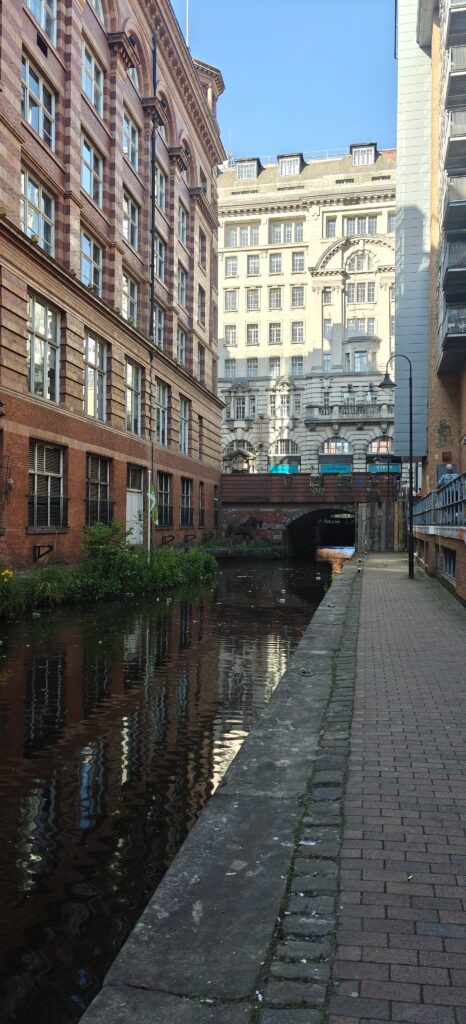
An do ends another day, with quite a few ticks. This week is going well.