Paddington – Liskeard (via Westbury and Yeovil) – Looe – Liskeard – Plymouth – Bristol TM – Chippenham – Trowbridge – Bristol TM – Birmingham New street – Derby – Nottingham – Worksop
Yesterday had gone well. I’d achieved the following objectives:
- The Joint line between Lincoln and Doncaster
- The line between New Mills and Manchester
- The lines to Rose Hill, Glossop and Hadfield
These could all be cut from my itinerary later in the week giving me more off-train leisure time or time to recover from train problems.
I’d also seen a lot of very nice scenery. But now, back to the travel.
Train 11 – Paddington to Liskeard
Trip details
| From | Paddington | To | Liskeard |
| Time due | 23:45 (yesterday) | 06:12 | |
| Actual Time | 23:34 | 06:00 | |
| Operator | Great Western | Headcode | 1C50 |
| Miles | 248m 01ch | ||
| Stations called at | 9 | Train | 57604 + LHCS |
I walked on to the platform at Paddington, together with about a third of the refugees from the first class lounge. I was in the rear carriage so found my cabin very quickly, dumped my bags then got off again to see what’s what.
I walked to the front of the train to see that would be hauling us. It was this. 57604 Pendennis Castle.
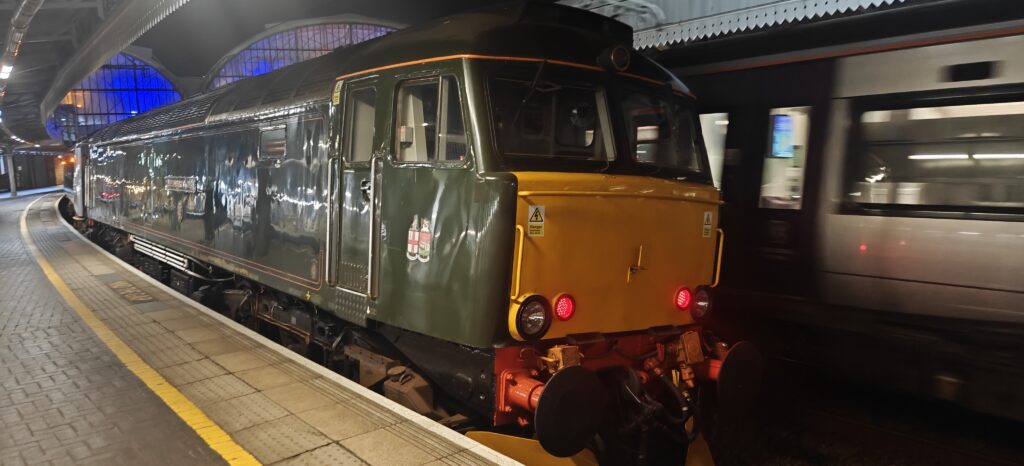

Once upon a time it was a class 47 (47209), also known as a Brush Type 4 or a Duff. When I was young these were ubiquitous, hauling both goods and passenger trains all over the network. Some Class 47s were ‘remanufactured’ between 1998 and 2004 to become Class 57. So they’re not exactly new engines but much of their innards dates from the remanufacture and they work well.
I’d had a long day. I had to visit the comfortable lounge car but I didn’t stay long. It was busy – I had to share my table. The stewardess was friendly and efficient. There doesn’t seem to be much in the way of meals on offer but I ate something, perhaps cheese and biscuits. While sitting in the lounge a stewardess appeared in the doorway and asked if I was Mr. Wheatley. I didn’t deny it. She wanted to know what I wanted for breakfast, and at what time. I was getting off early and Realtimetrains seemed to thing we’d arrive ahead of time, but she was insistent. So we agreed on a bacon roll and tea at 6 o’clock, just in time for me to take it with me on arrival at Liskeard.
I was still in the lounge when we made a stop at Reading to allow the engine at the back of the train to be detached. We set up off again via Reading West and on towards Newbury and Westbury. I assumed we would take the same route as the daytime West Country trains, although I knew that sleepers take a variety of routes due to over night engineering.
I was soon back in my cabin, having semi-successfully negotiated the narrow corridor on the rocking train. So what are the cabins like?
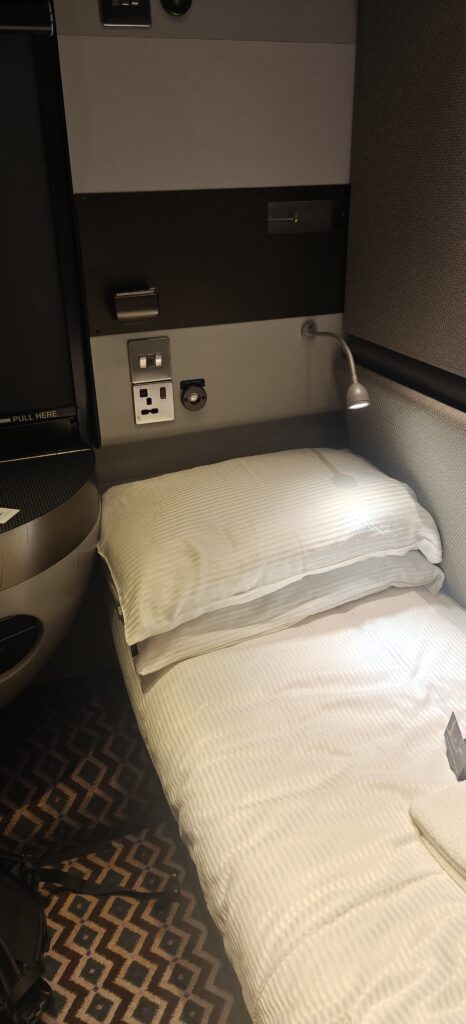
They’re are air-conditioned and have (almost) all you need. You can charge your phone, there’s a reading light and a wash basin with hot and cold water. Storage is close to non-existent, with, I think, just a single hanger. Bags have to just sit in the limited floor space.
Maybe it was because I was near the end of the car but I noticed the motion of the train far more than on previous sleeper journeys. It was the curves; I felt the centrifugal force pushing me up or down the (comfortable) bed.
I slept poorly, partly because I’d raised the blind so that I could see out during the journey. Whenever we were at or passing a station platform the lights strobed across my face. Again, I hadn’t seen that as a problem on previous sleeper rides.
But I did get some sleep before being woken up by particularly bright lights sweeping across my face as the train slowed to a halt. Where were we?
We were at a platform but I couldn’t see any name boards. We were on platform 3 and there was platform 4 on the other side of the island. Taunton? It didn’t look like Taunton to me so I admitted defeat and turned to Realtimetrains (RTT). We were at Exeter St. David’s. This confused me because I know the layout of that station. Something wasn’t right. I looked again at RTT. It said something along the lines of ‘stops to allow engine to run round the train’. Aha! I couldn’t identify the station because we had arrived from the ‘wrong’ end, heading towards London. I knew that after Reading we’d taken the Berks and Hants Line towards Westbury and I’d noticed that we were booked to make an extended stop at Castle Cary. I’d assumed that we’d continue from there to Taunton and Exeter. But no. After Castle Cary we’d taken the single-track branch down to Yeovil then the West of England Line via Honiton and Exeter Central. That may explain the bendy journey.
Now Pendennis Castle was at the wrong end of the train. I heard the engine revving as it moved away from the train, then pass by on the adjacent track. I had been at the back, but now I was at the front of the train so felt the full force as the engine backed onto the train then, after coupling, conducted a tug test. And once we were away I was now just yards from the 126-litre engine. But I did get some more sleep before my alarm woke me at 05:40. I visited one of the toilets at the end of the carriage (still clean and fresh) then returned to my cabin for a quick shave. We were almost at Liskeard, the train’s first stop in Cornwall. I was getting my bags ready when the stewardess knocked with my bacon roll and tea. How civilised.
Bus 2 – Liskeard to Looe
I sat on the platform for a while and ate my breakfast, throwing the last piece of my roll to an attendant seagull. I know that some of Cornwall has been resignalled but that hasn’t yet affected Looe, which still has its very ancient-looking GWR lower-quadrant semaphore signals.
This morning I wanted to travel on the Looe branch. The train isn’t due for over an hour. But the sun is out and this isn’t an unpleasant place to sit, watching the people on the other platform waiting for their train for Plymouth, Exeter or London. I could quite happily have wandered over to the Looe platform but I do prefer to be on the move and I knew there was a bus due that would take me where I wanted to go. I left the station and waited at the bus stop almost directly outside. There was a couple of young lads already waiting, who asked me if I knew the whereabouts of a campsite they were hoping to work at. I didn’t. They also asked me what the bus fare was likely to be, and I could help there: it would be the standard English fare cap of £3 each.
There was an interesting pair of houses opposite with a shared porch with wrought-iron gates. I wonder if they’ve always been houses?

The bus, operated by Plymouth Go on route 73, was going via Looe to Polperro. It set off from the station. We crossed the railway bridge and after a few hundred yards made a sharp bend to the left, then the fun began. For about the next five miles the roads were single track, and the driver was in a hurry. The two lads had quizzed him at some length, presumably still looking for their campsite, so maybe he was making up time. Our headlong dash was interrupted occasionally by a fierce brake application then a hurried reversal to a passing place. It’s some time since I last drove in Cornwall so maybe I’d forgotten, but down there you soon get in the habit of driving backwards nearly as often as forwards. And, I found out, that applies equally to buses.
But the driver, who seemed much too nice to be deliberately trying to kill me, got me to Looe in one piece. I overshot the station because I still had time in hand. I got off at The Bridge in the centre of Looe and had a wander. It’s a nice spot with yachts in the river valley, but some way from the seafront. I started walking in that direction but gave up and walked up to the station.

On the station platform there are panels telling of its history. As has so often been the case the line was truncated and the original buildings demolished. The site of the old Looe station is now a police station. Despite having a considerable summer traffic Looe only ever had a single platform, part of which survives. Arriving trains had to go forwards towards a shed and yard beyond the station to run round. At one time a line extended beyond the yard to the harbour but only for goods traffic.
Evidence for the truncation can be seen in the milepost opposite the platform. It’s not 0, but a quarter of a mile, showing the extent of the lost track.
The platform has a bench and a small masonry waiting room with various posters in. It’s rudimentary but not unpleasant. It’s better than those places with nothing but a plastic bus shelter and it is in a nice location on the river.

Train 12 – Looe to Liskeard
Trip details
| From | Looe | To | Liskeard |
| Time due | 07:54 | 08:26 | |
| Actual Time | 07:55 | 08:25 | |
| Operator | GWR | Headcode | 2L72 |
| Miles | 8m 47ch | ||
| Stations called at | 2 (but see text) | Unit | 720560 |
More or less on time, the train from Liskeard arrived. It was a class 150 Sprinter. I remember travelling on one of those between Swindon and Cheltenham many years ago, when they were new. It was the first time I’d seen a toilet on a train with a power-operated door. Those toilets are confusing to this day but that’s because every train has a subtly different set of controls. But back then they were distinctly novel, even futuristic. On that journey back in the ’80s a lady was disturbed when somebody opened the door she’d failed to lock. I’ve never forgotten that, and I doubt if she has, either.
The passenger information system (PIS) announced that this was the train for Liskeard, calling only at Coombe Junction Halt. Realtimetrains and the published timetable both seemed to think that the train was calling at all stations, but all except Combe Junction were request stops. In any case we didn’t actually stop at any interim station.
I was one of only two passengers on the train. I suppose it was a bit early in both the year and the day to get many Looe holidaymakers going for a day trip. The conductor stopped for a chat. He’d never seen an All Lines Rover before so asked me about my plans.
The journey is very pleasant in this old train with large windows, being mostly along the river valley. At times the railway runs on a causeway alongside the river. The valley is steep-sided and tree-lined. This must be one of the most scenic lines in the country but doesn’t seem to be that well-known.

Towards the end of the journey there’s a trailing junction. The train stops just beyond it to give back the staff that has allowed it to travel on the Looe branch, which is single track throughout. The staff is a simple but effective safety measure: if you don’t physically possess it you may not enter the branch.
The train then drew forward a very short distance (less than 200m) into the platform of Coombe Junction Halt. Despite it only being 200m from the junction only two trains a day in each direction make the effort. More should – it’s quite a nice station, although its sparse service doesn’t exactly bring in the masses. Only 140 people used it last year, less than three per week. But this station is the entire reason I’m here. I’ve never been here before, so it’s another tick.

The driver now changes ends to take us up to Liskeard. We’re down in the valley, some 150 feet below the main line. First we headed back to the junction, then stopped. The guard jumped out to work the ground frame (i.e. change the points) and the signalman gave us a token granting us permission to go onto the single line up to Liskeard. The train moved over the points and the guard rejoined the train. I read somewhere that this movement over the points is the only place in the country where a passenger train with a guard is allowed to move without the guard being on board. I’d guess that’s because he needs to put the points back in their normal position and lock the ground frame.
We made a long, climbing loop, under the Liskeard Viaduct, the A38 (twice) then up to Liskeard Station, where we terminated in a platform that’s perpendicular to the main line platforms.

Being single track throughout, the Looe line has a single train that shuttles back and forth all day. So how does the train get onto the branch in the first place? It goes, in slightly simplified form, like this. The unit comes from Laira depot at Plymouth early in the morning, crosses Brunel’s Royal Albert Bridge and stops just beyond Liskeard station. The driver changes ends then uses a crossover to stop at the Plymouth-bound platform at Liskeard. The signaller gives the driver the token authorising them to enter the single line towards Coombe Junction. They then are routed into Liskeard Yard. Just beyond the yard the driver changes ends, again, and runs the train forward into the platform dedicated to the Looe service. The driver then changes ends yet again to take the train to Coombe Junction, where they change ends one more time time before taking the train on to Looe. The drivers get their steps in on this line.
Liskeard yard is not rated for passenger traffic, so through passenger trains cannot operate between the main line and the Looe branch. Well, I’ve been on several passenger trains on goods lines but special arrangements need to be made. Points that may lack the right safety equipment will be padlocked into position, and other rules may apply such as prohibiting another train for being anywhere near a position that could compromise safety. Another way that passenger lines differ from goods lines is in the level of maintenance. Goods lines tend to be at the back of the queue.
I was told of a railtour recently that had arranged to travel over the Looe branch. It had come from the main line so needed to travel through Liskeard yard with passengers on board. All of the necessary arrangements were made and the special train travelled through the yard and along the branch to Looe, then back up the branch, through the yard and onto the main line. Railtours are usually long trains hauled by a heavy locomotive, whereas the usual train on the Looe branch is a light diesel multiple unit. Apparently the yard could not be used after the tour had passed because the rails were now wide to gauge. In other words they’d splayed under the weight of the tour because they weren’t fixed in place as firmly as they should have been. Oops.
Train 13 – Liskeard to Plymouth
Trip details
| From | Liskeard | To | Plymouth |
| Time due | 08:39 | 09:08 | |
| Actual Time | 08:38 | 09:07 | |
| Operator | GWR | Headcode | 1A78 |
| Miles | 17m 61ch | ||
| Stations called at | 3 | Unit | 800026 |
I was back on Liskeard station, two and a half hours after my early-morning arrival. I had a couple of targets this morning before heading up to the Midlands but I really wanted to sort out my ticket. I’d planned to catch this train to Plymouth and change for a train to Bristol, but the ticket must come first. Luckily I have some slack in my schedule today.
My train is a 125mph GWR Intercity Express Train (IET), a Hitachi train capable of running on 25kV AC overhead power as well as diesel (luckily for us). They come in 5- and 9-car variants. This is a single 5-car unit but will couple up with another unit at Plymouth, making a ten-car train that will go on via Exeter and the direct route to Reading and London.
Loading is light and the time passes quickly as we pass Cornish viaducts, hills and the always-a-pleasure Royal Albert Bridge, finally negotiating the surprisingly extensive Plymouth suburbs to Plymouth station.

Train 14 – Plymouth to Bristol Temple Meads
Trip details
| From | Plymouth | To | Bristol TM |
| Time due | 10:27 | 12:25 | |
| Actual Time | 10:27 | 12:25 | |
| Operator | Cross Country | Headcode | 1S47 |
| Miles | 127m 44ch | ||
| Stations called at | 6 | Unit | 221132 |
I had to change trains for Bristol. There are through trains from Liskeard but not for some time: it’s quicker to change. In any case I needed to change my ticket and Plymouth is a busy regional station. When I discovered the ticket error I asked for advice on r/uktrains. The replies varied in quality, as is usual on social media. Some thought I should simply buy a new ticket and send the old one in, hoping to get a sympathetic hearing from GWR. Others felt it was my fault for not checking the ticket carefully. I thought there was quite a good chance that GWR would share that view. One person was absolutely certain: a GWR ticket office would be unable to ‘non-issue’ my ticket because that has to be done within a two-hour window. It would be a matter for the refunds team at Swindon or maybe even a general manager. So I wasn’t optimistic as I approached the ticket windows at Plymouth.
I explained the problem and the person I spoke to immediately understood. That was a good start as it is all a bit esoteric. I told her my theory as to how the problem had arisen, a communications error between two staff at Paddington, both trying to be helpful. I told her it had been suggested that I buy a new ticket then write in and appeal to GWR’s better nature. Her reply: “I suppose you could do that, but why should you? It was our mistake.” She went to speak to a supervisor then returned to say that the supervisor was on the phone asking for advice and would be with me soon.
I stepped aside to allow other customers to be served. The supervisor arrived and we moved to a closed window. She thought she could resolve the problem. I’m ashamed to have forgotten her name – it may have been Ann, so I’ll call her that. She had an accent from the north-east, and she was just about the most helpful person I’ve ever met. There were problems to overcome, an obvious one was that it’s hard by design to refund tickets costing several hundred pounds. But further problems were caused by the fact that GWR is replacing its ticket issuing system. Paddington, which issued my ticket, is running on the new platform, Plymouth on the old. That meant a walk to another window as the terminal there was on the new system. Ann had little experience of the new system but was able to obtain a login and she had a fat printed manual. She said that my request was good training for her.
She asked which train I was catching. I wanted the 09:27. It was already 09:20 but I told her was happy to miss it if I could resolve the ticket. I was at that ticket window for a long time while she patiently went through the steps of a very unusual transaction on an unfamiliar platform, as well as issuing my new ticket on the old system – itself an uncommon thing to do. I hear that many booking clerks are never asked for an All Lines Rover during their entire career. But she got there, refunding my old ticket and issuing a new one, and I’m very grateful to her.
I was now an hour behind my plans, but it didn’t matter. One of my trains today was infrequent so my delay at Plymouth just meant that my planned lunch stop later in Bristol was cancelled. I boarded an Edinburgh-bound Cross-Country service that started its journey here at Plymouth. Having had my ticket reissued (on a proper credit-card sized piece of cardboard, instead of half a roll of bog paper) I was now sitting in First. It was almost full and I had to relinquish my seat at one point when its rightful owner got on. I found another.
Many people on this train seemed to be on holiday from Australia. They were impressed by the Dawlish coast section of the line. At Exeter a rather frail old man was helped onto the train by GWR assistance staff. They had to leave the train before he was properly settled to avoid being carried towards Scotland, so I helped him with his bag and coat. The lady next to me seemed to think I should have gone further, asking him his destination in case he was confused. He was physically frail but he seemed fully compos mentis to me.
Train 15 – Bristol Temple Meads to Severn Beach
Trip details
| From | Bristol TM | To | Severn Beach |
| Time due | 12:46 | 13:24 | |
| Actual Time | 12:51 | 13:30 | |
| Operator | GWR | Headcode | 2K30 |
| Miles | 13m 37ch | ||
| Stations called at | 11 | Unit | 166220 |
I got off two hours later at Bristol Temple Meads, refreshed by tea and biscuits. The station was a building site, with areas of the platforms, and a lot of signage, blocked off. My next train was to Severn Beach. This is an urban commuter service, a far cry from my last train on its 6.5 hour journey. I’d expected it to use the bay platform as I’d thought that the Severn Beach service normally started here, but it turns out that some come to/from Weston-Super-Mare. It arrived a few minutes late and took several minutes to get away as the crew changed.
While waiting at Bristol a freight train passed through bound for Crewe hauling what appeared to be nuclear flasks. I don’t know the class 68 locomotive as you don’t get many round my way. This train had 68016 at one end and 68005 at the other, should you care.
We headed off towards Bristol Parkway, passing the oddly-named Dr. Day’s Junction. There are four tracks along this stretch now. When I first became aware of this line there were only two. We passed Lawrence Hill and Stapleton Road stations. I came through here on a diverted train a long time ago, probably the 1970s when visiting Barry. Stapleton Road was one of those scruffy run-down inner-city stations with crumbling masonry, peeling paint and (you just knew) a leaking roof. Hornsey and Harringay West, stations that I knew, were the same at the time; in fact most quietish inner-city stations were. You don’t see station like that any more. Many have had their buildings demolished and a shelter put in their place, and the unlucky ones have closed down completely. Stapleton Road now has minimal facilities but it all seems to be maintained; at the least it doesn’t look as if it could collapse at any moment.
After Stapleton Road the Severn Beach Line diverges from the main line at Narroways Hill Junction. There are several more stations on this line, which is largely single-track, although the size of the many tunnels suggest that wasn’t always the case. The train passed over an impressive urban viaduct just before Redland
I was riding on a Class 166, a three-car train dating from 1993. This surprised me because I always associate these trains with services in the London commuter belt, but then I remembered that GWR had deployed theirs more widely after the Elizabeth Line took over some of their services from Paddington. They’re good, with air-conditioning and two toilets, a big step up from the Pacers that ran in this area until recently. This train wasn’t crowded but there was a steady traffic, with people getting on and off at every stop.
There are yards alongside the line between Avonmouth and St. Andrew’s Road but I saw no signs of activity. Not so long ago there was a bulk handling terminal of some sort where trains would discharge their hopper wagons using locomotives fitted with slow-speed controls, allowing them to proceed at very slow speed while they emptied their wagons.
There’s a junction after St. Andrew’s Road that heads across to Filton and a complex junction leading to just about every line in the area. That line was notable for a wide level crossing that allowed aircraft to cross the line. At one time that may have included Concorde. That would have made a good picture.
Severn Beach station is a terminus. The line used to continue a short distance beyond to Pilning then a junction with the line leading to the Severn Tunnel. There are no station buildings other than a bus shelter but there are several benches. which are nice enough places to sit in good weather. Only half of the platform is still in use but that’s plenty.
Just before I reached the terminus I received a phone call. It was Ann from GWR Plymouth. She was confirming that the refund of my old ticket had now completed so the money was about to arrive back on my credit card. What a star!
I was going to return on the same train but it was to remain at Severn Beach for about half an hour. I went for a stroll. There are panels about the station’s history. It seems that Severn Beach was quite a resort in the early 20th century, with all manner of attractions including a funfair, swimming pool, boating lake, putting green and miniature railway. One of the reasons for its eventual demise as a resort was the silting of the Severn estuary. An attempt was made to ameliorate that by importing sand, but the developers were not King Canute and any hint of a sandy beach was lost. In any case, like so many other seaside resorts, Severn Beach had lost its market and amenities by the 1970s.
I walked up to the sea (estuary?) wall. There’s wasn’t much to see there, apart from a good view of the Prince of Wales Bridge.

They do still have a decent baker’s shop, so I bought a steak and pepper slice, a huge chunk of bread pudding and a cup of tea for my lunch, to eat back on the platform or train. That took longer than expected since I queued behind my train crew plus two other GWR workers who obviously recognise it as a better than average place to buy lunch.
Train 16 – Severn Beach to Bristol Temple Meads
Trip details
| From | Severn Beach | To | Bristol TM |
| Time due | 14:01 | 14:43 | |
| Actual Time | 14:00 | 14:47 | |
| Operator | GWR | Headcode | 2K33 |
| Miles | 13m 37ch | ||
| Stations called at | 11 | Unit | 166220 |
I settled back on the class 166, choosing a seat as I usually do – facing the direction of travel and on the right, preferably with a table if the train is quiet. On the way back to Bristol I saw that we’d followed the estuary for quite some time and it was a nice ride. There was an ornate iron foot-bridge at Redbridge.
The train was delayed on its journey because of trespassing but the hold-up wasn’t long, getting us to Temple Meads just four minutes late.
Well, that’s the Severn Beach line ticked off.
Train 17 – Bristol Temple Meads to Chippenham
Trip details
| From | Bristol TM | To | Chippenham |
| Time due | 15:00 | 15:24 | |
| Actual Time | 15:00 | 15:23 | |
| Operator | GWR | Headcode | 1A25 |
| Miles | 24m 34ch | ||
| Stations called at | 2 | Unit | 802114 |
Back to the building site that was Bristol Temple Meads. The next tick was to be the line through Melksham. I’d never heard of Melksham until I worked on a project in Salisbury. I’d occasionally need to visit a computer centre at Corsham and I had to drive through Melksham to get there. I found out, a decade or two ago, that Melksham had a station, but was served by very few passenger trains and the odd freight. It now has a slightly better passenger service, but only one train every two hours in each direction, and a path for freight about once per hour. I don’t know how often the freight paths are used.
To get to Melksham I needed to get first to Chippenham. The train started its journey at Bristol and was another of GWR’s IETs, this one having 9 carriages, and bound eventually for Paddington.
The ride through Bath is quite nice. You can see why they don’t want overhead wires here. Just before Chippenham was Thingley Junction, the trailing junction for Melksham. Beyond Thingley were electrification pylons but no wires, yet. This dual-mode train would stay on diesel for now.
The train was very quiet. I think I accepted free tea despite not going very far, reaching Chippenham in 23 minutes.
Train 18 – Chippenham to Trowbridge via Melksham
Trip details
| From | Chippenham | To | Trowbridge |
| Time due | 15:31 | 15:50 | |
| Actual Time | 15:30 | 15:49 | |
| Operator | GWR | Headcode | 2M28 |
| Miles | 11m 65ch | ||
| Stations called at | 2 | Unit | 158762 |
Chippenham is an unexceptional station in most respects. It has a single island platform with trains to Swindon and London leaving from one face and trains to Bristol (and beyond) and Westbury on the other. It does, however, have a nice listed Bath Stone station building. The building is on something that has every appearance of a platform, including a painted white edge, tactile strip and a yellow line to stop you getting too close to passing trains. But there aren’t any passing trains. The track bed alongside the platform hasn’t had any rails for a long, long time. What is the point of the yellow line?
My train soon arrived, having only come from Swindon. It was class 158 Super Sprinter, Not new, but a comfortable train. It only had two cars but that wasn’t a problem as it had plenty of empty seats and a working toilet.
Not long after setting off from Chippenham we reached Thingley Junction again. We took the diverging route to the south. It was now another single-track scenic ride though rural England. We stopped at Melksham (tick!) then continued, ending up on the double-line route between Bath and Westbury, used by services running from Bristol and beyond to Westbury, Salisbury and Southampton.
Train 19 – Trowbridge to Bristol Temple Meads
Trip details
| From | Trowbridge | To | Bristol TM |
| Time due | 16:09 | 16:46 | |
| Actual Time | 16:08 | 16:45 | |
| Operator | GWR | Headcode | 2E71 |
| Miles | 24m 18ch | ||
| Stations called at | 5 | Unit | 165102 |
I crossed the line to await a train back to Bristol. It was now school chucking-out time and there was quite a crowd on the platform I’d just got off at, but my platform was quiet. A couple of trains in quick succession took care of the schoolkids and my train arrived very soon after.
This was a GWR class 165, another unit I associate with West London, Bucks and Berks but now in use on other parts of GWR’s network. These are the inner-suburban version of the Class 166, with denser seating, no aircon and a single toilet. I was glad of the latter as I’d been convinced that the Class 165 had no toilet at all. Glad to be wrong on this occasion.
We went up past the junction for Melksham and on to Bradford-on-Avon. This is an attractive line and Bradford-on-Avon a nice-looking station. There is a particularly good stretch as the train travels alongside the river. After Bradford we stopped at another pair of small, attractive, country stations before joining the main London – Bristol line and finding ourselves back at Bath. We then called at minor stations, reaching Temple Meads after a journey of a bit under 40 minutes. This was where I got off, although the train was to reverse and continue to Gloucester. The Class 165 had been very quiet at Trowbridge had had gained passengers stop by stop, and was just about full (and rather noisy) by Bristol.
Train 20 – Bristol Temple Meads to Birmingham New Street
Trip details
| From | Bristol TM | To | Birmingham NS |
| Time due | 17:00 | 18:25 | |
| Actual Time | 17:00 | 18:25 | |
| Operator | Cross Country | Headcode | 1M61 |
| Miles | 91m 49ch | ||
| Stations called at | 3 | Unit | 220003 |
I found my platform and had a short wait for my second Cross Country Voyager of the day. These trains were notorious for their smell, which was unpleasant and seemed to come from the train toilets. But in my writeup of my 2019 Rover I noted that the problem seemed to be fixed. These are, at heart, decent trains. They’re capable of cruising at 125mph and some of them can tilt, although Cross Country’s examples have not done so for some years. The main reason many people dislike Voyagers is because they’re simply too short for the services they operate on. They come in 4-car and 5-car varieties. They are sometimes run in multiple but not on most routes. There simply aren’t enough trains or seats for Cross Country to run a decent service so overcrowding is common. This train was running from Paignton to Manchester via Birmingham and there are only four cars, one of them first class.
We were leaving Bristol at 1700, so it would be busy. Still, it wasn’t as crowded as I feared. There were several empty seats in first. The problem was the seat I had booked wasn’t one of them. I asked the occupant to move. I felt a slight pang of guilt, but for all I knew the train could fill and I might find myself seatless,
The train stopped only at Bristol Parkway and Cheltenham reaching New Street in less than 90 minutes. We approached Birmingham in a roundabout way, looping around the centre and entering New Street from the London End. New Street has unusual flexibility in that there are loops to north and south that allow this type of manoeuvre. I was getting off this train at New Street but it could now make an easy getaway from Birmingham towards Wolverhampton, the West Coast Main Line and Manchester.
Train 21 – Birmingham New Street to Derby
Trip details
| From | Birmingham NS | To | Derby |
| Time due | 19:03 | 19:40 | |
| Actual Time | 19:03 | 19:39 | |
| Operator | Cross Country | Headcode | 1E63 |
| Miles | 41m 20ch | ||
| Stations called at | 3 | Unit | 221116 |
I had a few minutes to spare at New Street so went up to the concourse to buy sandwiches. I then descended into the abyss to wait for my next train. I was waiting for another Cross Country (XC) service, but of a different nature to the train I’d just left.
Cross Country use their Voyagers on several long-distance routes. They’re fast, have reservable seats, First Class and catering. But XC also have two routes that are different. One is very familiar to me, the one from Stansted Airport to Birmingham New Street. The other less so, the long trek from Cardiff to Nottingham. All Cross Country services visit New Street and it was one of those I awaited. These Cross Country-lite services use Class 170 trains. Once upon a time they had the amenities I listed earlier, but no longer. And they are often only two or three cars long. On some busy trains, such as the short workings between Birmingham and Leicester, they pair units up, but even so I only ever wait for a Cross Country Class 170 with some trepidation, unless it’s at Stansted or Audley End where I’m sure to get a seat.
I wanted to go to Nottingham and the train I was waiting for had come from Cardiff with just two carriages. The platform was packed. A very large number of people got off and the crowd surged. It’s often a surprise just how many people a train can hold but I didn’t want to take the risk. I’d let this train go.
Instead of a direct but crowded train direct to Nottingham I’d now have to change at Derby. Even so, we’re making fewer stops so I won’t be badly delayed – in theory. We’ll see.
The train was another Cross Country Voyager service running from the South West to the North East. it was terminating in Derby. I can’t find this train in the current timetable so either it’s been extended to Newcastle since the May timetable change or it was not running all of the way on the day I travelled. The train was busy but I found a seat and, after stopping at Tamworth and Burton-on-Trent, reached Derby in just over half an hour.
Train 22 – Derby to Nottingham
Trip details
| From | Derby | To | Nottingham |
| Time due | 19:47 | 20:15 | |
| Actual Time | 19:47 | 20:14 | |
| Operator | Cross Country | Headcode | 2A39 |
| Miles | 16m 00ch | ||
| Stations called at | 4 | Unit | 170418 |
Now for the last leg – or what would have been the last leg, if I’d not managed to cock up my sleeping arrangements. As we pulled in to Derby station I saw a train leaving with Nottingham on the front. Had my connection left early? It seemed unlikely. But it was probably the train that I’d failed to board at New Street because another train to Nottingham arrived in just a few minutes time and was running punctually. It was another East Midlands Railway Class 170. Pleasant enough, and not too busy, following so closely behind the other service. It had come from Matlock so I don’t suppose that many people want to travel from there to Derby, let alone Nottingham, early on a Tuesday evening.
I have little to say about this journey. It made three station stops before arriving at Nottingham. Nottingham has long platforms. Some, including the one we arrived at, are over 300m. My train ran forward to the furthest extent of the platform before stopping. As the train was only two cars, so about 46m long, it was a long and unnecessary walk back to the footbridge, which was almost at the far end of the platform. I realise that for operational reasons they may want the train right up by the starting signal, but why not stop near the exit and bridge first? I suppose then there’s a need for a formal dispatch process and it’s cheaper not to provide it.
Train 23 – Nottingham to Worksop
Trip details
| From | Nottingham | To | Worksop |
| Time due | 20:25 | 21:33 | |
| Actual Time | 20:27 | 21:30 | |
| Operator | East Midlands | Headcode | 2W27 |
| Miles | 32m 07ch | ||
| Stations called at | 11 | Unit | 170204 |
My plan had been to sleep in Nottingham and make an early start in the morning. But I manged to balls up the booking. I’d cancelled the room I’d booked for the wrong date but was unable to book an affordable room in its place. So I’d make what was supposed to have been tomorrow’s first trip, along the Robin Hood Line.
The Robin Hood line is a stopping service that was restored in stages between 1993 and 1998 after falling victim to the Beeching cuts in the 1960s. There were collieries and power stations along the route making this an important line for freight until recently, so most of the line never closed, although parts did, the modern service using alternative lines where 1970s cuts severed the direct route.
Before I could travel on this line, named after a range of hills it tunnels through, I had to find my train. So after the lengthy trek along the platform from my last train I crossed the footbridge. There were two trains present, neither giving any indication of their destination. The indicator board told me which part of the platform I needed, roughly, but the trains weren’t neatly and obviously positioned in the platform. Even so, I thought I knew what I was doing and boarded the train, my confidence boosted by the fact that the doors were enabled. I knew which direction we’d be leaving so there was the small problem of another train in the platform between us and the open rails. Maybe that was my train and I was on the wrong one? I was slightly anxious as I’d already been called by my hotel, demanding to know where I was, and I didn’t have much spare time before they’d lock me out. But the other train cleared off just a couple of minutes before ours was due to leave, so all was well.
We left a couple of minutes late for no obvious reason other than it was quiet. the platform was deserted and nobody seemed to be in a rush. I wasn’t really in the mood to enjoy this line. 38 hours of almost continuous travel had taken its toll and I needed sleep, or at least rest.
The train? Another East Midlands service. in fact another East Midlands 170. As you know these are fine.
I did notice a few things: the tram line runs alongside for some of the earlier parts of the journey. But I didn’t notice very much as the light was failing and I may have dozed off. One sign on a station caught my eye, reminding passengers that drinking alcohol on the Robin Hood Line isn’t allowed. Are there any other National Rail lines in England (outside London) with such a rule? I wonder how enforceable it is? ScotRail has just admitted that they don’t enforce their network-wide ban, introduced during Covid, because they’re not sure they have the powers to do so.
Perhaps the most important intermediate station on the line is Mansfield. I remember when railways timetables used to show trains stopping at Alfreton and Mansfield Parkway. This was the railhead for Mansfield before this line reopened and was about 7.5 miles away. That station, which was only opened in 1973 due to the closure of other lines, is now just Alfreton and it seems to no longer have through services to London.
Although the passenger service makes this line look like a simple route between its termini a look at a map will show that’s it’s quite complex, with multiple current and former junctions. Most is double-track but a short section section is single-track where half of the track bed has been sacrificed to the trams. Another section is single presumably due to economies made when recreating the through passenger line by joining up pieces of other lines in the 1990s. But, like almost all reopenings, this line is a success, giving mobility opportunities to many who’d lacked it.
And so to Worksop. After Shirebrook station, a name I associate with mining, our line meets another line at a right-angle. Trains may take either fork but all passenger trains go to the right to pass over a level crossing into Worksop station.
My hotel is yards away and I need my sleep.